In today’s fast-paced digital ecosystem, small and medium-sized enterprises (SMEs) face unprecedented digital security risks. Many owners incorrectly assume that hackers only target multinational corporations with deep financial pockets. However, recent cyber threat statistics reveal that small enterprises are actually the primary target for modern hackers. Because smaller organizations often lack dedicated IT departments and enterprise-grade infrastructure, cybercriminals view them as low-hanging fruit. Implementing practical cybersecurity tips for small business operations is no longer an optional IT luxury; it is an absolute necessity for long-term survival.
When a small enterprise suffers a digital security breach, the consequences are rarely limited to temporary downtime. The financial fallout from ransomware, compromised client databases, and legal penalties can permanently shutter a growing enterprise. Fortunately, establishing a bulletproof defensive perimeter does not require a million-dollar IT budget. By focusing on practical cybersecurity tips for small business environments, management can dramatically reduce risk profiles, protect confidential customer data, and maintain operational continuity.
In this comprehensive 2026 guide, we will unpack actionable strategies, proven protocols, and essential cybersecurity tips for small business security frameworks that you can implement starting today.
Why Cybersecurity Matters for Small Businesses More Than Ever
The modern digital landscape has fundamentally changed how companies operate. Cloud computing, remote work models, automated payment gateways, and interconnected software tools have increased operational efficiency. However, they have also expanded the potential attack surface for malicious cyber actors. Understanding effective cybersecurity tips for small business survival begins with recognizing why your organization is targeted in the first place.
The True Cost of a Data Breach
When cybercriminals breach a corporate network, the immediate expense involves system remediation and incident recovery. However, the hidden costs are often far more damaging. Lost revenue during operational downtime, forensic investigation fees, regulatory compliance fines, and extortion demands can quickly cascade. Implementing reliable cybersecurity tips for small business safety helps mitigate these disastrous financial surprises before they occur.
Protecting Customer Trust and Reputation
Reputation is everything for a growing enterprise. If clients discover that their payment credentials, social security numbers, or private emails were exposed due to lax protocols, rebuilding that trust is nearly impossible. Demonstrating a proactive stance by adopting verified cybersecurity tips for small business data defense builds long-term customer loyalty and differentiates your brand from competitors.
Regulatory and Legal Compliance Standard
Data protection regulations such as GDPR, CCPA, and industry-specific compliance rules apply to organizations of all sizes. Failing to safeguard customer records can result in massive legal liabilities and government fines. Following structured cybersecurity tips for small business compliance ensures that your organization stays on the right side of the law while operating safely online.
Financial & Operational Impact
Beyond immediate data recovery, operational disruption represents a major threat during a security breach. When network infrastructure goes offline, revenue generation halts entirely while fixed overhead costs continue to accumulate. Implementing proactive cybersecurity tips for small business continuity mitigates operational friction and protects revenue streams. Furthermore, commercial insurance providers increasingly require proof of standardized cybersecurity tips for small business compliance before underwriting cyber liability policies. Without verified security measures, obtaining coverage becomes difficult and expensive, making cybersecurity tips for small business risk management essential for financial protection.
Top 10 Cybersecurity Tips for Small Business Protection
1. Implement Multi-Factor Authentication (MFA) Across All Accounts
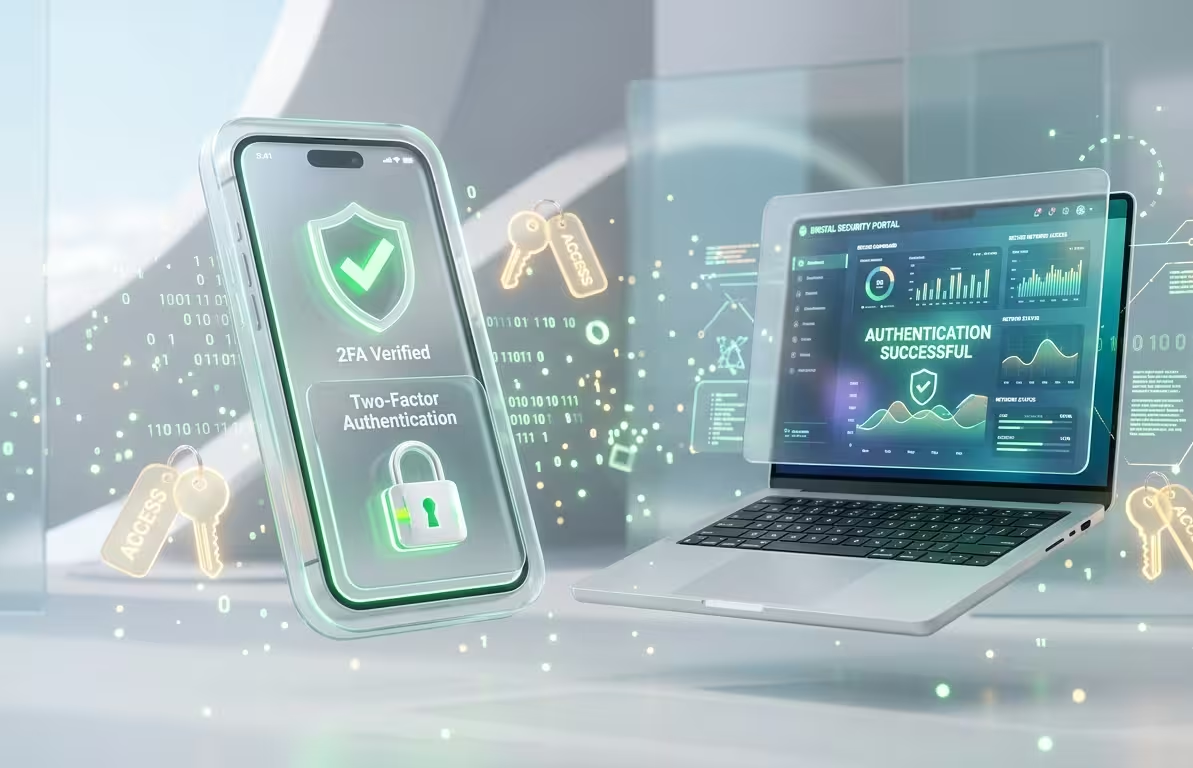
Relying solely on standard passwords to secure sensitive accounts is one of the most dangerous oversights a company can make. Automated hacking tools can crack weak or reused credentials in a matter of seconds. Therefore, the absolute first entry on our list of cybersecurity tips for small business defense is mandating Multi-Factor Authentication (MFA) across every single application, email portal, and administrative dashboard.
MFA requires users to present two or more verification factors to gain access to a resource. This usually involves something you know (a password) combined with something you have (an authenticator app code or hardware token). Even if a cybercriminal successfully steals an employee’s password through a phishing email, MFA prevents them from logging into the account without the secondary verification code.
When configuring MFA across your organization, prioritize time-based authenticator apps (such as Google Authenticator, Microsoft Authenticator, or 1Password) over traditional SMS-based text messages. SMS verification codes can be intercepted through SIM-swapping techniques, making dedicated authenticator applications a vastly more secure choice. Integrating MFA is one of the simplest yet most effective cybersecurity tips for small business networks available today.
2. Enforce Strong Password Policies and Enterprise Password Managers
Human error remains one of the greatest vulnerabilities in corporate security. Employees naturally lean toward simple, easy-to-remember passwords like “Company2026!” or reuse the exact same credential across multiple personal and professional logins. If a single platform suffers a breach, credential-stuffing bots instantly test those leaked combinations across corporate accounts.
To combat this vulnerability, applying rigorous credential management policies is paramount among essential cybersecurity tips for small business owners. Mandate that every team member uses complex passwords containing a randomized mix of uppercase letters, lowercase letters, numbers, and special symbols, with a minimum length of 14 to 16 characters.
Because expecting staff to memorize dozens of 16-character random passwords is impractical, deploy an enterprise-grade password manager such as Bitwarden, 1Password, or Dashlane. These platforms generate, encrypt, and securely store complex passwords for every platform your business utilizes. Employees only need to memorize one master key password, while the software handles seamless, secure autocompletion across browsers. Adopting modern password management tools simplifies everyday workflows while strictly enforcing core cybersecurity tips for small business hygiene. To learn more about securing your online assets, check out our guide on essential digital safety protocols.
3. Train Employees on Phishing and Social Engineering Attacks
You can invest thousands of dollars in high-end firewalls and security software, but a single worker clicking a malicious link in an email can bypass those defenses instantly. Phishing remains the single most common entry point for ransomware infestations, credential theft, and unauthorized network intrusions. Therefore, comprehensive employee security awareness education ranks at the very top of vital cybersecurity tips for small business operations.
Modern social engineering tactics are extremely sophisticated. Cybercriminals no longer send obvious scam emails written in broken grammar. Today, they utilize AI-assisted tools to draft highly authentic, personalized emails appearing to come from trusted vendors, executive team members, or bank authorities. Urgent requests demanding immediate wire transfers or password resets should always trigger immediate verification steps. In fact, according to official guidance from the Cybersecurity and Infrastructure Security Agency (CISA), over 90% of all successful cyberattacks start with a phishing email.
To safeguard your workplace:
-
Conduct regular security awareness sessions explaining how to inspect sender email addresses, verify URLs before clicking, and spot suspicious attachments.
-
Implement simulated phishing campaigns to test employee alertness in real-world scenarios.
-
Establish a clear, non-punitive protocol for employees to report suspicious emails immediately to your IT lead.
When your team knows how to identify social engineering tactics, they transform from potential entry points into your strongest line of defense. Consistent staff training enforces fundamental cybersecurity tips for small business safety culture.
4. Keep All Software, Workstations, and Systems Updated
Operating systems, web browsers, firewall firmware, and business applications frequently release software updates. While many users ignore these update notifications, they often contain vital patches for newly discovered security vulnerabilities. Cybercriminals actively write automated code to exploit these known software flaws. Skipping updates is one of the quickest ways to expose your business to automated network attacks.
To enforce effective cybersecurity tips for small business device maintenance, enable automatic software updates across all company laptops, desktops, and mobile hardware. Furthermore, implement centralized Patch Management software if you manage multiple team devices. Systematically closing software security holes ensures hackers cannot leverage public software vulnerabilities against your internal assets.
5. Secure Your Wi-Fi Networks and Remote Workflows
With hybrid and remote work models becoming standard, securing communication channels is crucial. Standard consumer Wi-Fi routers often come with default admin passwords and weak encryption protocols that invite unauthorized access. Modern cybersecurity tips for small business networks require building a robust virtual perimeter for both home and office Wi-Fi setups.
Always change factory default router passwords, enable WPA3 or WPA2-Enterprise encryption, and hide your SSID network broadcast if necessary. Never permit visitors or non-employees to connect to your primary corporate network. Instead, set up a isolated “Guest Wi-Fi” network that strictly separates visitor devices from internal corporate databases. Additionally, require all remote workers to connect through a secure Virtual Private Network (VPN) whenever accessing office files over public connections.
6. Establish a Strict Data Backup and Recovery Plan
Ransomware attacks encrypt critical company records and demand hefty ransom payments in exchange for decryption keys. Paying cybercriminals never guarantees data recovery, and it marks your organization as a target for future extortion. The ultimate defense against ransomware is maintaining consistent, immutable data backups.
A foundational standard among cybersecurity tips for small business resilience is the 3-2-1 Backup Strategy:
-
Maintain 3 total copies of your important business data.
-
Store backups on 2 different types of storage media (e.g., local external drives and cloud storage).
-
Keep at least 1 backup copy completely offsite and disconnected (air-gapped) from your main network.
Regularly test your backup restoration procedures to verify that data can be fully restored in the event of hardware failure, natural disasters, or malicious malware infections.

7. Restrict Employee Access Controls (Principle of Least Privilege)
Giving every staff member administrative access to corporate files, accounting software, and hosting servers creates massive security exposure. If a junior employee’s account gets compromised, hackers instantly gain full administrative rights over your entire network infrastructure.
Applying the Principle of Least Privilege (PoLP) is a core pillar of actionable cybersecurity tips for small business management. Grant employees access only to the specific tools, databases, and files strictly necessary to perform their daily job duties. Immediately revoke administrative credentials, access tokens, and enterprise logins whenever an employee leaves the company or transitions to a different department.
8. Secure Mobile Devices and BYOD (Bring Your Own Device) Policies
Modern smartphones, tablets, and personal laptops store massive amounts of sensitive business communication, corporate emails, and confidential files. However, mobile devices are easily lost, stolen, or compromised over unencrypted public Wi-Fi access points.
If your team operates under a Bring Your Own Device (BYOD) framework, enforcing clear cybersecurity tips for small business mobile compliance is mandatory:
-
Require biometric authentication or strong PIN passwords on all mobile screens.
-
Mandate full-disk encryption on every device accessing corporate tools.
-
Implement Mobile Device Management (MDM) software to remotely wipe business data if a smartphone is lost or stolen.
9. Conduct Regular Vulnerability Assessments and Security Audits
Cybersecurity is not a one-time project; it is an ongoing operational process. New system vulnerabilities emerge daily, and configurations can shift over time as your business grows. Periodically evaluating your digital architecture helps you identify security gaps before malicious hackers discover them.
Integrating routine security audits into your operational calendar is one of the most proactive cybersecurity tips for small business leaders can adopt. Utilize free and open-source vulnerability scanners (such as OpenVAS or Nmap) or hire a reputable third-party cybersecurity firm to perform an annual penetration test. Auditing your setup ensures firewalls, software updates, and access controls function exactly as intended.
10. Create an Incident Response Plan (IRP)
When a digital security incident occurs, chaos and confusion can paralyze an organization. Having a pre-established Incident Response Plan (IRP) ensures your team reacts swiftly and decisively to contain the breach, minimize financial loss, and preserve evidence.
An effective incident response protocol includes:
-
Identification: Clear steps to determine whether a security breach has occurred.
-
Containment: Instructions to isolate affected hardware and disconnect infected networks.
-
Eradication & Recovery: Procedures for removing threats and safely restoring systems from clean backups.
-
Communication: Standardized legal and public relations notification guidelines for affected customers and regulatory bodies.
Documenting these steps turns critical theoretical cybersecurity tips for small business readiness into an actionable playbook during emergencies.
Key Cyber Threats Facing Small Businesses in 2026
Understanding current attack vectors empowers small business owners to adapt their defensive strategies effectively. Cybercriminals constantly evolve their tactics to bypass conventional security tools.
| Threat Type | How It Impacts Small Business | Primary Defensive Strategy |
| Ransomware as a Service (RaaS) | Encrypts critical company databases and demands extortion payments. | Isolated offsite backups & modern endpoint security. |
| AI-Driven Phishing | Highly convincing, automated emails mimicking trusted partners. | Continuous employee awareness training & MFA. |
| Supply Chain Attacks | Cybercriminals compromise smaller third-party vendors to reach larger client networks. | Strict third-party access control & network segmentation. |
| Credential Stuffing | Automated bots use stolen passwords to compromise corporate logins. | Enterprise password managers & mandatory MFA. |
Essential Cybersecurity Checklist for Small Business
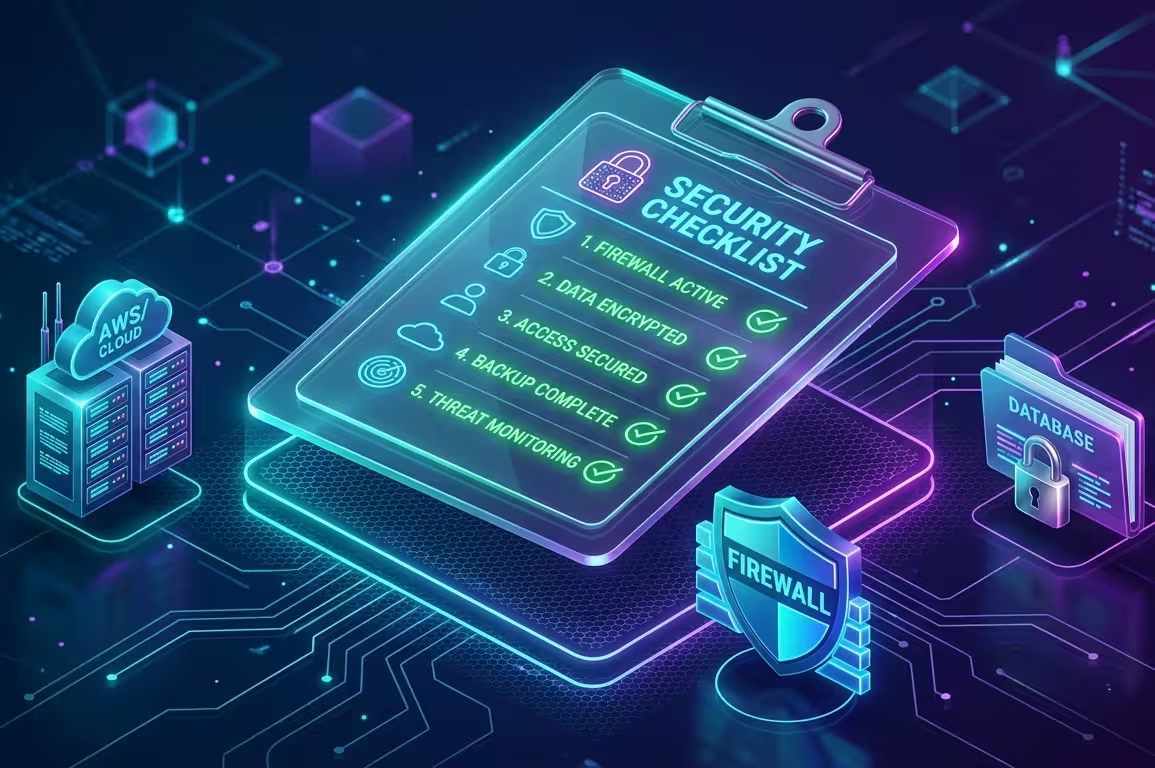
Use this practical visual checklist to keep your organization’s security posture on track throughout the year:
Daily & Weekly Tasks
-
Verify that automatic software and antivirus definition updates are active on all devices.
-
Ensure all automated cloud and local data backups completed successfully without errors.
-
Monitor administrative login logs for suspicious, unauthorized access attempts.
Monthly & Quarterly Tasks
-
Review employee access permissions and revoke unnecessary administrative rights.
-
Conduct a simulated phishing exercise to refresh staff awareness against social engineering threats.
-
Perform a routine test restore of system data from an offsite backup image.
Yearly Tasks
-
Perform a comprehensive cybersecurity audit and vulnerability assessment across all systems.
-
Update your written Incident Response Plan and review disaster protocols with team leaders.
-
Audit third-party vendor access permissions and renew software licensing agreements.
Consistently reviewing this operational checklist ensures long-term compliance with foundational cybersecurity tips for small business practices.
Frequently Asked Questions (FAQs)
1. What is the single most important cybersecurity tip for a small business?
While layered defense is critical, implementing Multi-Factor Authentication (MFA) across all email portals and business tools is widely considered the single most effective action. MFA neutralizes over 99% of automated credential-based attacks.
2. How much should a small enterprise spend on cybersecurity tools?
A small business does not need a massive budget to achieve high security. Allocating roughly 5% to 10% of your overall IT budget toward enterprise password managers, reputable endpoint protection, automated cloud backups, and employee security training provides exceptional coverage.
3. Can a small business recover from a major ransomware attack?
Yes, but recovery relies heavily on having recent, uncorrupted, offsite data backups. Organizations without clean, air-gapped backups often face massive financial losses, permanent data corruption, or business failure following a severe ransomware incident.
4. Are cloud platforms more secure than local business servers?
In most cases, yes. Reputable enterprise cloud providers (like Microsoft 365, Google Workspace, and AWS) invest heavily in physical security, infrastructure patching, and automated threat detection. However, small business owners must still configure access controls, password policies, and MFA properly to protect their cloud environments.
5. How often should a small enterprise review its digital safety rules?
Reviewing your operational cybersecurity tips for small business protocols should occur at least bi-annually, or immediately following major software upgrades and operational expansions.
6. Is antivirus software enough to protect a growing company?
No, traditional antivirus is only one layer of defense. Comprehensive cybersecurity tips for small business strategy requires combining endpoint protection with MFA, strong password rules, backup systems, and employee security awareness.
Conclusion & Actionable Next Steps
Securing your growing enterprise against modern cyber threats does not require complex enterprise machinery or unlimited financial resources. Securing your growing enterprise against modern cyber threats aligns with the FTC Small Business Cybersecurity Framework. By taking a proactive, structured approach and implementing these fundamental cybersecurity tips for small business operations ranging from multi-factor authentication and staff phishing education to strict backup protocols you dramatically raise the bar against potential attackers.
Do not wait for a security incident or costly data breach to test your defensive setup. Begin by auditing your existing access credentials, enforcing strong password standards today, and scheduling regular data backups. Building a resilient cyber defense is a continuous journey that safeguards your corporate assets, protects customer trust, and secures your business growth for years to come.