1. The Modern Enterprise Threat Landscape & CSIRT Necessity
Modern enterprise organizations face an increasingly hostile cyber threat landscape characterized by sophisticated ransomware campaigns, automated supply chain compromises, and unpatched zero-day exploits. While perimeter defenses such as firewalls and endpoint protection platforms provide initial filtering, determined adversaries inevitably breach external perimeters. Relying exclusively on outsourced security vendors or delayed third-party incident handlers introduces severe operational lag during an active breach, directly increasing remediation costs and regulatory penalties.
To mitigate these catastrophic risks, forward-thinking tech leaders are shifting away from purely reactive remediation strategies. Whether managing technical infrastructure for a B2B cold email agency or safeguarding enterprise cloud environments, developing a structured building internal incident response team framework allows organizations to establish dedicated threat hunting, containment, and forensic analysis capabilities inside their own infrastructure. Having an in-house security team ensures immediate contextual awareness, rapid triage, and total operational control when critical assets are targeted.
Adopting a modern building internal incident response team framework transforms how an enterprise handles digital crises. Instead of panicking during an active malware infection or unauthorized database access, trained internal personnel execute pre-established playbooks that isolate compromised systems without shutting down entire revenue-generating operations. This comprehensive guide outlines the exact technical blueprint, staffing structures, tool stacks, and operational workflows required for building internal incident response team framework protocols from the ground up.
2. What is an Incident Response Team Framework & Core Objectives?
A building internal incident response team framework serves as the operational foundation for an organization’s Computer Security Incident Response Team (CSIRT). Unlike standard IT helpdesks that handle routine software configuration, password resets, and hardware provisioning, a specialized CSIRT focuses entirely on identifying, mitigating, and neutralizing active security threats across enterprise infrastructure.
Core Objectives of an Internal Response Team
An effective building internal incident response team framework operates around four non-negotiable operational goals:
- Rapid Threat Detection and Verification: Minimizing dwell time by quickly distinguishing genuine security breaches from false positive security alerts generated by automated monitoring tools.
- Surgical Threat Containment: Isolating infected network segments or compromised user accounts immediately to prevent lateral attacker movement without causing unnecessary system downtime.
- Evidence Preservation and Digital Forensics: Collecting volatile memory dumps, system logs, and network packet captures in a forensically sound manner to satisfy legal compliance and regulatory requirements.
- Business Continuity and Post-Breach Restoration: Returning impacted critical applications to normal operational status securely while closing the initial vector of compromise.
Outsourced MSSP vs. Internal Incident Response Team
While managed security service providers offer basic off-site monitoring, relying entirely on third parties creates significant friction during severe security breaches. The comparison table below highlights why organizations transition to an internal operational model:
| Operational Metric | External Managed Security Provider (MSSP) | Internal Incident Response Team (CSIRT) | Strategic Advantage |
| Mean Time to Respond (MTTR) | Hours to days due to SLA queues and escalation layers | Minutes via direct system access and automated isolation | Drastically reduces attacker dwell time |
| Infrastructure Context | Generic network understanding requiring client explanation | Deep institutional knowledge of internal data flows | Faster root-cause identification |
| Data Confidentiality | Sensitive log telemetry shared with third-party vendors | Complete internal control over forensic evidence | Lower risk of secondary data exposure |
| Long-Term Operational Cost | High recurring retainer fees with overage charges | Fixed operational investment in internal talent | Higher return on investment over time |
Implementing a dedicated building internal incident response team framework bridges the operational gap between initial intrusion detection and complete threat eradication, establishing long-term cyber resilience for the enterprise.
3. CSIRT Team Structure, Roles & Key Responsibilities
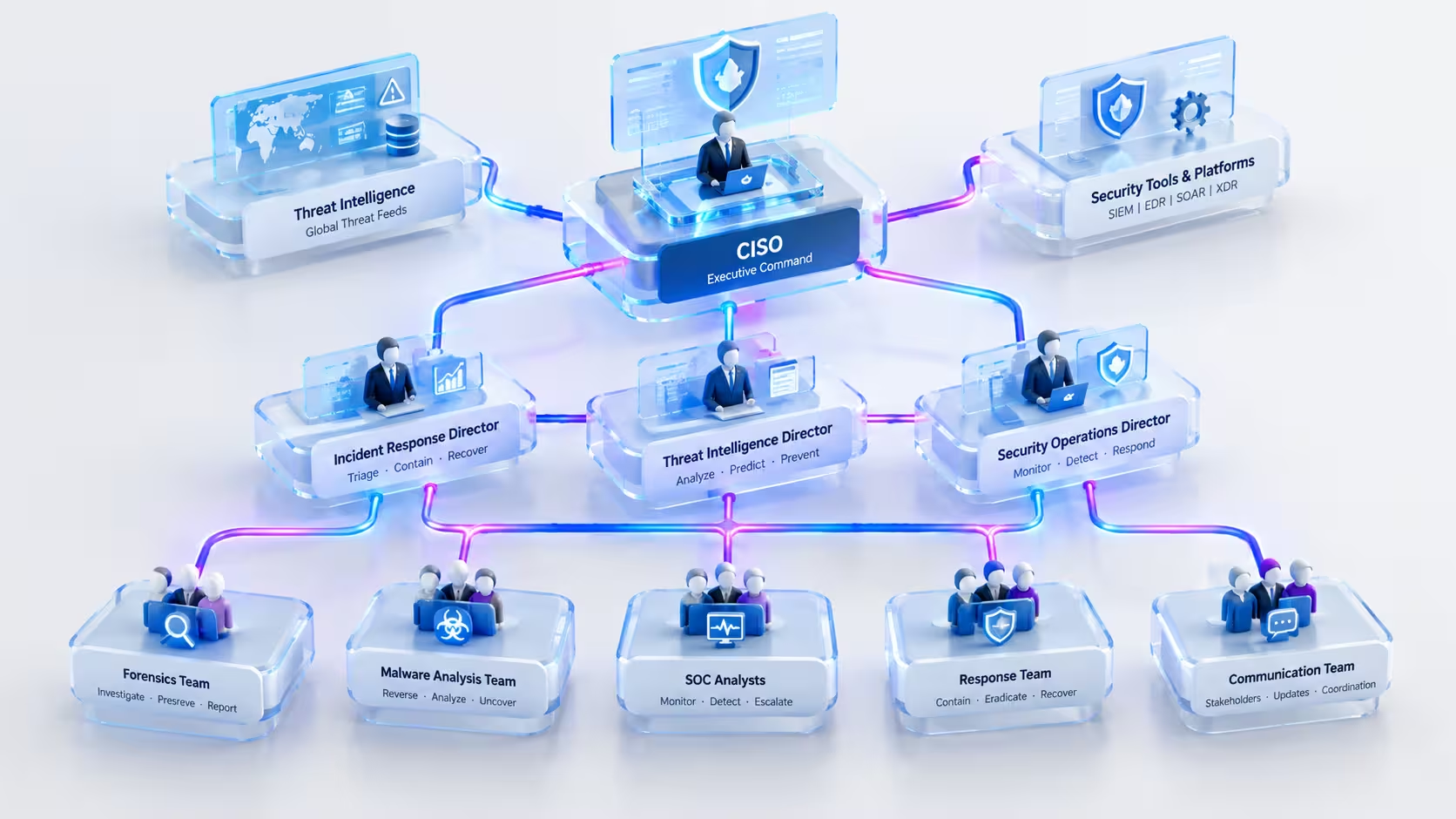
Structuring an operational CSIRT requires defining clear technical and administrative command hierarchies. When executing a building internal incident response team framework, clear assignment of responsibilities prevents overlapping duties, minimizes communication bottlenecks, and ensures rapid execution during high-stress containment operations.
Core Tactical Roles Within the Framework
The technical core of the response unit focuses directly on threat identification, containment execution, and forensic investigation.
- Incident Commander (IC): The Incident Commander leads the active response process. This individual makes high-level operational decisions, coordinates tactical efforts across specialized sub-teams, and serves as the primary liaison to C-suite executives and board members.
- Technical Lead & DFIR Analysts: Digital Forensics and Incident Response (DFIR) specialists perform deep-dive technical investigations. They are responsible for extracting volatile RAM images, analyzing unformatted disk dumps, dissecting network packet captures, and reverse-engineering suspicious executable binaries to determine the exact mechanics of an intrusion.
- Threat Intelligence Analysts: These engineers monitor external threat feeds, match incoming Indicators of Compromise (IoCs) against internal log telemetry, and track known Advanced Persistent Threat (APT) Tactics, Techniques, and Procedures (TTPs) aligned with the MITRE ATT&CK framework.
- Infrastructure & Security Engineers: Systems administrators and network security leads execute real-time containment commands, such as applying emergency firewall filters, re-routing BGP routes, invalidating Active Directory kerberos tickets, and provisioning isolated recovery environments.
Non-Technical Cross-Functional Liaisons
An enterprise building internal incident response team framework must extend beyond engineering departments to incorporate crucial legal, regulatory, and public relations representatives:
- Legal Counsel and Privacy Officers: Navigating complex international breach disclosure mandates requires immediate legal oversight. Legal leads determine compliance obligations under regulations such as the SEC 4-day material breach disclosure rule, GDPR 72-hour notification timelines, and state-level privacy mandates.
- Corporate Communications & PR Team: Unapproved public disclosures can cause severe reputational and financial damage. PR liaisons craft clear, accurate external statements for media outlets, investors, and impacted customers while strictly adhering to guidance provided by legal counsel.
- Human Resources and Internal Communications: When an incident involves insider threats or employee credential theft, HR professionals manage internal policy enforcement, chain-of-custody protocols for corporate devices, and sensitive employee communications.
Staffing Models: Dedicated CSIRT vs. Hybrid SOC
Selecting the right operational model depends heavily on organizational size, infrastructure complexity, and operational budgets:
- Dedicated Internal CSIRT: A fully staffed 24/7/365 internal operational team. While this model requires significant capital expenditure for headcount and continuous training, it delivers the fastest response times and total operational control.
- Hybrid Tiered SOC Model: Mid-market organizations often adopt a hybrid building internal incident response team framework. In this arrangement, an external Security Operations Center handles round-the-clock Tier 1 and Tier 2 log monitoring, while an in-house Incident Commander and specialized Tier 3 engineers step in to manage validated critical incidents.
4. Step-by-Step NIST Incident Response Lifecycle Implementation
Adopting a standardized lifecycle ensures that when a compromise occurs, technical operators respond with methodical precision rather than uncoordinated actions. The NIST SP 800-61 Computer Security Incident Handling Guide provides the global baseline for structuring response workflows. Integrating this standardized lifecycle inside a building internal incident response team framework allows organizations to systematically move from initial signal detection through complete infrastructure recovery.
Phase 1: Preparation
Proactive preparation forms the bedrock of a successful building internal incident response team framework. During this phase, security engineers build the technical infrastructure and administrative controls necessary to handle active threats before an attack occurs:
- Centralized Telemetry Ingestion: Deploying endpoint detection agents across all cloud and on-premises servers, configuring active syslog forwarders, and establishing centralized log retention policies.
- Immutable Backup Architectures: Establishing isolated, air-gapped, or write-once-read-many (WORM) storage repositories for critical databases and system state backups to resist ransomware encryption attempts.
- Pre-Approved Containment Authority: Obtaining C-suite sign-off on emergency operational procedures, allowing response operators to sever network connectivity or isolate production servers without prior approval during verified high-severity incidents.
Phase 2: Detection and Analysis
Detection begins when monitoring security tools or internal users report anomalous behavior. The primary objective during this phase is to rapidly validate alerts and determine the full blast radius of the intrusion.
Operators correlate log sources such as Domain Controller authentication events, firewall connection state tables, and cloud API access logs to identify Indicators of Compromise (IoCs). Analysts map observed attacker activity directly against the MITRE ATT&CK framework to identify lateral movement techniques, credential dumping attempts, or unauthorized command-and-control (C2) communication channels.
Phase 3: Containment, Eradication, and Recovery
Once a threat is confirmed, operators execute a three-part mitigation workflow to eliminate the adversary’s access:
- Surgical Containment: Analysts isolate affected endpoints using endpoint management controls or dedicated VLAN segmentation. Privileged Active Directory credentials are invalidated, active OAuth tokens are revoked, and suspicious external IP addresses are blocked at the perimeter firewall.
- System Eradication: Operators remove the adversary’s persistence mechanisms from the environment. This includes deleting malicious scheduled tasks, removing registry run keys, purging unauthorized web shells, and closing exposed entry vectors.
- Staged Recovery: Infrastructure teams restore impacted services using clean, verified backup images. Restored assets are placed under heightened telemetry logging for 30 days to ensure the attacker cannot leverage dormant secondary backdoors.
Phase 4: Post-Incident Activity
The final phase focuses on institutional learning and procedural refinement. Within 72 hours of incident closure, the Incident Commander convenes a formal lessons-learned meeting with all stakeholders.
The team documents the exact timeline of events, evaluates response velocity, identifies tooling gaps, and updates operational playbooks. Continually refining the building internal incident response team framework after every operational incident guarantees that organizational defenses evolve at the same pace as modern threat actors.
5. Essential Tech Stack: SIEM, SOAR, EDR, and Forensics Tools
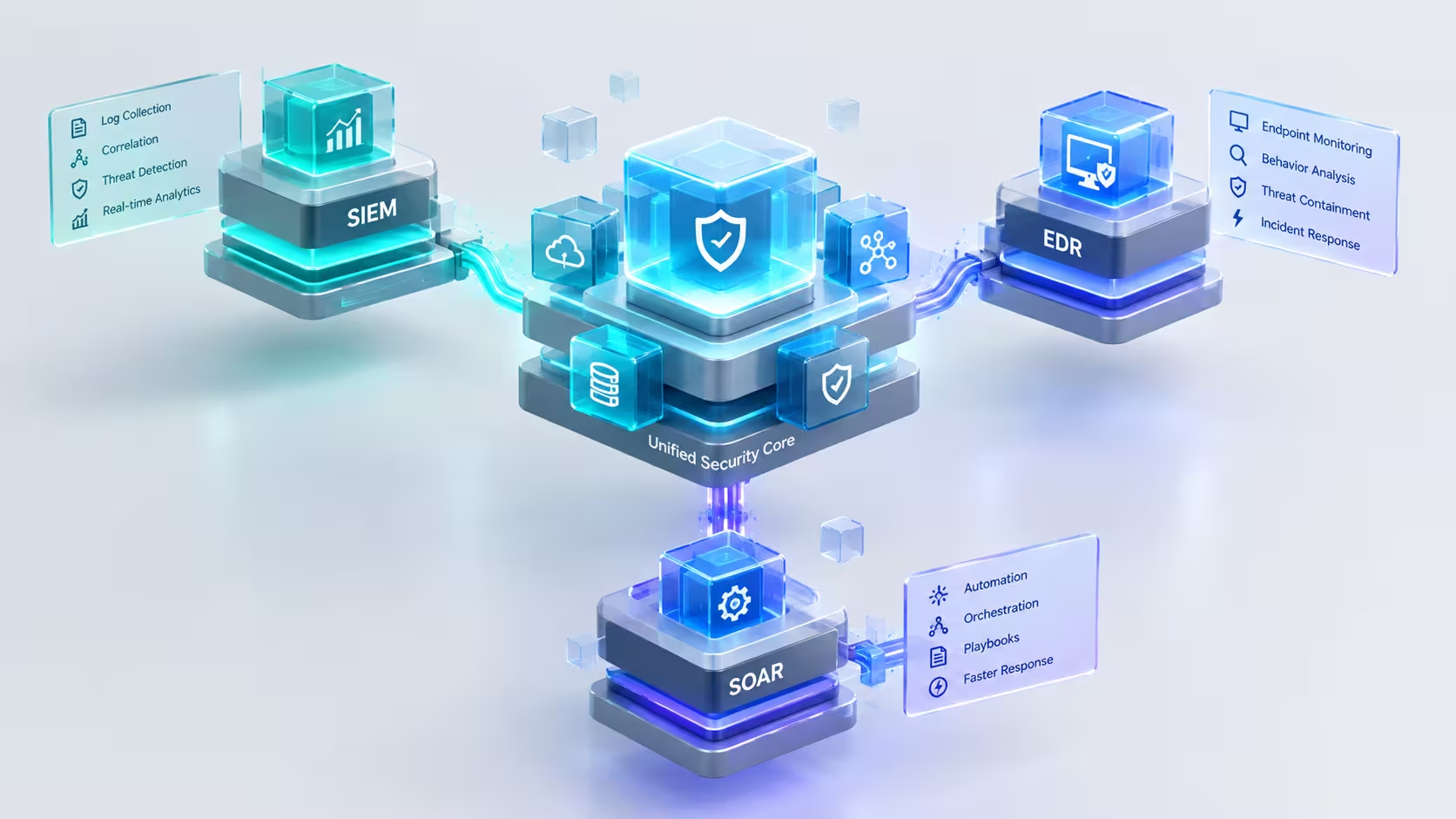
Equipping security operators with enterprise-grade tooling is a fundamental pillar when building internal incident response team framework capabilities. Without centralized visibility and automated triage tools, even highly skilled forensic analysts are unable to detect sophisticated intrusion vectors across modern hybrid infrastructures.
Centralized Visibility via SIEM & Data Lake Architecture
Security Information and Event Management (SIEM) platforms form the central nervous system of an enterprise response team. SIEM platforms aggregate, normalize, and correlate log telemetry collected across domain controllers, cloud infrastructure, firewalls, and application endpoints.
- Log Ingestion & Correlation Rules: Platforms such as Microsoft Sentinel and Splunk Enterprise Security ingest terabytes of daily event data. Advanced correlation engines analyze these logs against behavioral baselines to trigger alerts when abnormal administrative privileges or data exfiltration attempts occur.
- Long-Term Forensic Retention: Maintaining hot log retention for at least 90 days and cold storage for up to 365 days ensures that historical telemetry remains accessible during long-term APT investigations.
Endpoint Detection and Response (EDR/XDR)
Perimeter firewalls alone cannot stop modern identity-based attacks or fileless intrusions. Deploying Endpoint Detection and Response (EDR) or Extended Detection and Response (XDR) solutions across all physical and virtual endpoints is essential for any building internal incident response team framework.
Tools like CrowdStrike Falcon and SentinelOne Singularity provide continuous kernel-level process monitoring, memory scanning, and behavioral analysis. When an endpoint executes suspicious PowerShell scripts or attempts unauthorized LSASS process memory reads, EDR agents allow analysts to remotely isolate the device from the network with a single click while preserving a live administrative shell for triage.
Security Orchestration, Automation, and Response (SOAR)
High alert volume creates operational fatigue, causing security analysts to miss high-severity warnings. Integrating a SOAR platform such as Palo Alto Networks Cortex XSOAR or Swimlane into your building internal incident response team framework automates repetitive triage tasks:
- Automated Enrichment: Automatically querying file hashes against VirusTotal or checking IP reputations upon initial alert generation.
- Instant Playbook Execution: Revoking compromised user credentials in Active Directory and pushing temporary block rules to perimeter firewalls instantly upon detecting validated ransomware behavior.
Digital Forensics and Incident Response (DFIR) Tooling
When deep technical investigation is required, DFIR specialists rely on dedicated forensic software suites to extract and analyze evidence without altering host system states:
- Volatile Memory Analysis: Tools like Volatility and WinPmem capture and analyze volatile RAM dumps to recover unencrypted encryption keys, injected code blocks, and active network sockets.
- Disk Imaging and Artifact Extraction: KAPE (Kroll Artifact Parser and Extractor) and FTK Imager allow analysts to parse Windows event logs, registry hives, and NTFS Master File Tables (MFT) in minutes, rapidly establishing a precise timeline of attacker execution.
By pairing advanced SIEM, EDR, SOAR, and DFIR capabilities, a robust building internal incident response team framework provides the speed and technical visibility needed to neutralize advanced threats before they escalate into major business disruptions.
6. Developing Actionable Incident Response Playbooks
Abstract security policies are insufficient when responding to active breaches. Security operators need clear, step-by-step technical playbooks that outline immediate containment, analysis, and eradication actions. Integrating standardized playbooks inside a building internal incident response team framework ensures consistent execution and eliminates operational hesitation during high-stress security incidents.
Ransomware Outbreak and Encryption Playbook
Ransomware attacks propagate rapidly across network drives and target active backups. A dedicated playbook within the building internal incident response team framework outlines precise triage steps:
- Automated Host Isolation: Immediately trigger EDR isolations on infected hosts and sever local subnets to halt lateral movement via SMB/RPC protocols.
- Backup Protection: Verify that air-gapped or immutable cloud backups remain untouched, immediately revoking active domain admin credentials to prevent privilege abuse against backup repositories.
- Ransomware Identification: Extract binary samples, identify extension signatures, and query threat intelligence databases to determine if decryption keys exist or if specific C2 channels can be blocked.
Credential Compromise & Lateral Movement Playbook
Adversaries frequently leverage stolen administrator credentials to navigate internal networks unnoticed. When identity threats trigger alerts, the building internal incident response team framework dictates a strict identity containment workflow:
- Kerberos Ticket Reset: Execute a double-reset of the Active Directory Kerberos Ticket Granting Service account (krbtgt) to invalidate forged Golden or Silver Tickets across the domain.
- Session Revocation: Force global session terminations across identity providers (such as Microsoft Entra ID or Okta) and enforce immediate multi-factor authentication (MFA) re-challenge protocols.
- Privileged Account Audit: Audit all temporary group memberships and newly created service principals to verify that no secondary persistent backdoor accounts were injected.
Cloud Infrastructure Breach Playbook
Compromised cloud access keys can lead to rapid resource exploitation or total tenant hijacking. A modern building internal incident response team framework extends playbooks into AWS, Azure, and Google Cloud Platform (GCP) environments:
- IAM Role Invalidation: Instantly detach compromised IAM policies, delete compromised access keys, and apply explicit deny-all boundary policies to affected service roles.
- Snapshot Isolation: Freeze storage instances and create immutable snapshots of impacted virtual machines for off-site forensic extraction without taking down entire container clusters unnecessarily.
- Infrastructure-as-Code Reversion: Deploy clean environment states via Terraform or Ansible scripts to overwrite malicious modifications applied to cloud security groups or serverless functions.
By embedding actionable playbooks for ransomware, identity abuse, and cloud breaches into your building internal incident response team framework, analysts can respond with speed and precision, drastically reducing overall dwell time.
7. Training, Simulated Attacks, and Continuous Improvement
A static security policy quickly becomes obsolete without continuous testing against evolving adversarial tactics. Regularly conducting tabletop exercises and live red team simulations ensures that an organization’s building internal incident response team framework remains sharp and operationally effective. Tabletop scenarios bring together technical leads, legal advisers, and executive managers to walk through simulated breach events, verifying that escalation paths and decision-making hierarchies function smoothly under pressure. Advanced red teaming goes a step further by deploying authorized simulated attacks against live systems to test how effectively the building internal incident response team framework detects and neutralizes real-world intrusions.
Quantifying Operational Performance Through KPIs
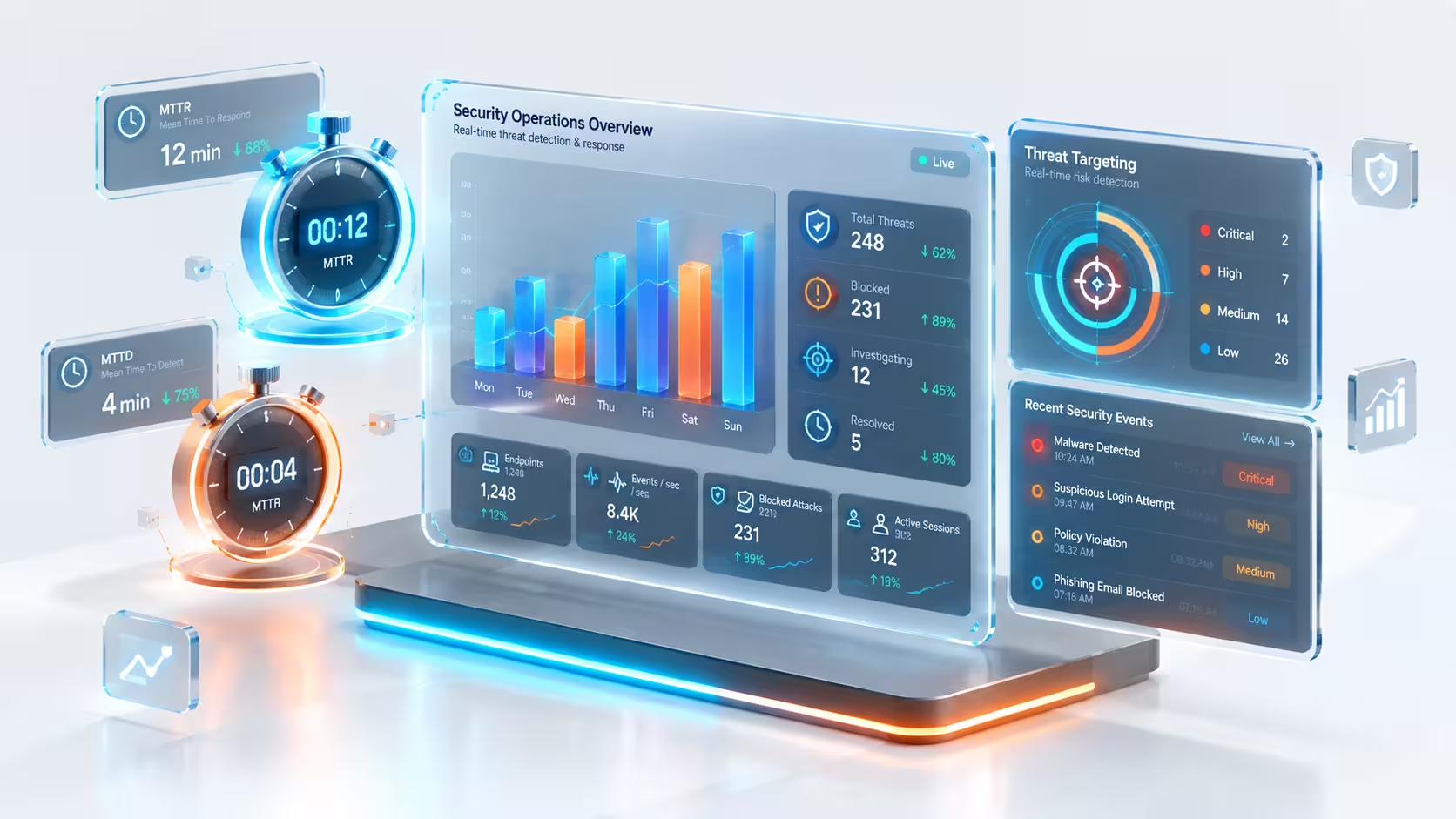
Measuring technical performance is essential for validating security investments and identifying operational bottlenecks during a breach. A mature building internal incident response team framework tracks key operational metrics to evaluate response efficiency:
- Mean Time to Detect (MTTD): The average time elapsed between an adversary’s initial entry into the network and the moment security analysts validate the alert.
- Mean Time to Acknowledge (MTTA): The time taken by a tier-2 or tier-3 analyst to begin active investigation upon receiving a validated alert.
- Mean Time to Respond (MTTR): The speed at which technical containment playbooks isolate affected host systems, revoke compromised credentials, and eliminate attacker persistence.
- False Positive Ratio: The percentage of security alerts that yield non-threatening activity, used to refine SIEM detection rules and reduce alert fatigue.
Continuous Iteration and Feedback Loops
Building cyber resilience requires turning every drill and real-world incident into actionable technical upgrades. Integrating continuous feedback loops into your building internal incident response team framework guarantees that post-incident reviews translate directly into updated firewall rules, optimized detection logic, and refined playbook workflows. Continuously training analysts on emerging threat vector developments ensures that your building internal incident response team framework adapts alongside the modern threat landscape.
Frequently Asked Questions (FAQs)
Q1: What is the primary difference between NIST and SANS incident response frameworks?
The NIST framework (SP 800-61) uses a 4-phase lifecycle (Preparation, Detection & Analysis, Containment/Eradication/Recovery, and Post-Incident Activity), whereas the SANS framework uses a 6-step model (Preparation, Identification, Containment, Eradication, Recovery, and Lessons Learned). Both methodologies align closely with official CISA cyber incident response guidance and provide robust blueprints when building internal incident response team framework procedures, with NIST being more common in enterprise compliance environments.
Q2: How many team members are required for a minimal viable internal CSIRT?
A minimal viable internal CSIRT can start with as few as 2 to 3 dedicated professionals: an Incident Commander and 1 to 2 Incident Response & Forensics Engineers. As infrastructure complexity expands, building internal incident response team framework hierarchies scale to include dedicated threat hunters, malware reverse-engineers, and legal liaisons.
Q3: How often should an enterprise update its internal incident response playbooks?
Security playbooks must be reviewed at least bi-annually, as well as immediately following any major security breach or significant infrastructure migration. Continually updating containment logic guarantees that a building internal incident response team framework remains effective against evolving threat actor Tactics, Techniques, and Procedures (TTPs).
Q4: Can small and mid-market businesses implement an incident response framework on a budget?
Yes. Smaller organizations can leverage open-source security solutions (such as Wazuh for SIEM, Security Onion for network monitoring, and Volatility for memory analysis) alongside native cloud security tools. Focusing on clear escalation pathways and automated containment rules allows mid-market businesses to execute a building internal incident response team framework without prohibitive enterprise software costs.
Final Thoughts
Building enterprise cyber resilience requires moving far beyond basic perimeter firewalls and passive antivirus software. Transitioning to a proactive operational posture through a building internal incident response team framework delivers the speed, contextual insight, and technical control necessary to contain active security breaches before they cause severe financial or reputational damage.
By establishing dedicated CSIRT roles, implementing standardized NIST response lifecycles, deploying centralized SIEM and EDR telemetry tools, and refining actionable containment playbooks, tech leaders can protect critical infrastructure against modern threat actors. Investing in a building internal incident response team framework transforms organizational security from reactive firefighting into an enterprise growth enabler.
Executing a building internal incident response team framework ensures long-term operational continuity and digital asset protection in an increasingly hostile global threat landscape.