
Introduction: The Evolution of B2B Lead Generation to AI-Driven ABM
The traditional B2B marketing playbook is broken. For over a decade, enterprise marketing teams relied on broad net-casting strategies generating hundreds of low-intent leads, downloading whitepapers, gating digital assets, and passing cold contacts to sales reps. In the modern B2B landscape, this volume-based approach leads to bloated sales pipelines, wasted ad spend, and low conversion rates. Enterprise buyers do not want generic sales pitches; they expect hyper-personalized, context-aware interactions long before they ever agree to a discovery call.
This paradigm shift has accelerated the adoption of Account-Based Marketing (ABM). Rather than targeting thousands of anonymous individuals, ABM treats each high-value target account as a market of one. However, traditional ABM execution required massive manual labor, complex cross-departmental coordination, and static lead scoring models that quickly became obsolete. In 2026, artificial intelligence has completely revolutionized this execution model through advanced machine learning, predictive intent signals, and automated orchestration workflows.
By leveraging modern ai account based marketing tools, enterprise organizations can identify in-market accounts weeks before those prospects fill out a contact form or request a demo. These platforms analyze millions of digital signals such as third-party article reads, software review site visits, intent searches, and hiring trends to construct precise buyer intent scores. Consequently, adopting specialized ai account based marketing tools allows revenue teams to move away from guesswork and focus their capital exclusively on high-value accounts that display immediate buying propensity.
Furthermore, the integration of generative AI and predictive analytics solves the historic friction between marketing and sales departments. Historically, marketing blamed sales for failing to follow up on leads, while sales complained that marketing leads lacked real buying authority. Enterprise ai account based marketing tools unify these departments around a single source of truth. By automating account selection, hyper-personalizing ad copy, dynamic web experiences, and outbound email sequences, revenue teams achieve unprecedented pipeline velocity.
As B2B purchasing cycles become more complex often involving 10 to 15 decision-makers per enterprise deal deploying robust ai account based marketing tools is no longer a luxury for enterprise revenue teams; it is a fundamental competitive necessity. This ultimate guide explores how modern AI-powered ABM platforms operate, the primary features to evaluate, and how your enterprise can leverage these tools to drive predictable, high-ticket revenue growth.
The Shift from Reactive Lead Scoring to Predictive Account Discovery
Historically, lead scoring was reactive. A prospect had to visit your pricing page or download an e-book before your team recognized their interest. Modern ai account based marketing tools invert this workflow by monitoring dark social channels, third-party publisher networks, and anonymized web traffic. By combining natural language processing (NLP) with predictive account scoring similar to how advanced AI search engines analyze search intent these platforms alert your sales team the moment an enterprise prospect begins researching your competitors or relevant industry pain points.
This transition from reactive tracking to proactive discovery dramatically shortens sales cycles. When marketing and sales align using comprehensive ai account based marketing tools, organizations report higher win rates, larger average contract values (ACV), and a significant reduction in customer acquisition costs (CAC).
What is AI-Driven Account-Based Marketing? Core Capabilities & Fundamentals
At its core, AI-driven Account-Based Marketing represents the convergence of machine learning, predictive analytics, intent signal processing, and automated orchestration to transform B2B revenue acquisition. Traditional ABM required marketing and sales teams to manually build static target account lists, construct single-use collateral, and guess when a company might be ready to purchase. In contrast, modern ai account based marketing tools replace static processes with dynamic, data-driven execution.
The Mechanics of Predictive Intent Data & Machine Learning
Modern enterprise ABM relies heavily on three layers of data processing to evaluate real-time buying propensity:
- First-Party Intent Signals: Behavioral tracking across your owned digital properties, including pricing page visits, product documentation reads, gated asset downloads, and chatbot interactions.
- Second-Party & Review Platform Signals: Insights gathered from tech review portals (such as G2 and TrustRadius), tracking when target enterprise accounts actively compare your product against direct competitors.
- Third-Party Intent Data Co-ops: Aggregated B2B web activity powered by networks like Bombora, analyzing web search surges and content consumption across thousands of business publications.
Advanced ai account based marketing tools ingest these multi-source data streams continuously. Machine learning algorithms process billions of data points to construct predictive account scores, accurately mapping where each target company sits within the B2B buying journey from early problem awareness to late-stage vendor evaluation.
Key Differences: Traditional ABM vs. AI-Automated ABM
To fully appreciate the business impact of adopting specialized ai account based marketing tools, enterprise revenue leaders must evaluate how AI transforms traditional ABM workflows:
- Target Account Selection: Traditional ABM relies on static firmographic filters (e.g., revenue, employee count). AI-driven ABM uses machine learning to identify hidden lookalike accounts and evaluate real-time buying intent.
- Content Personalization: Traditional ABM requires marketing teams to manually build bespoke landing pages. Modern ai account based marketing tools leverage generative AI to dynamically alter website headlines, ad copy, and value propositions based on the visiting account’s industry and specific intent signals.
- Campaign Orchestration: Traditional ABM relies on rigid email schedules and manual ad launches. AI-automated ABM triggers multi-channel workflows across programmatic ads, LinkedIn outreach, and sales rep alerts automatically when an account’s intent score crosses a defined threshold.
- Sales Alignment: Traditional ABM often suffers from delayed lead handoffs. Integrated ai account based marketing tools deliver real-time account intelligence and suggested action plans directly inside CRMs like Salesforce and HubSpot.
Dynamic Buying Committee Mapping
Enterprise software deals are rarely closed by a single point of contact. Modern B2B purchasing decisions typically involve a buying committee of 6 to 12 stakeholders across executive, IT, finance, and legal departments. Leading ai account based marketing tools utilize organizational graph algorithms to automatically map buying committees within target accounts, ensuring your automated campaigns engage every key stakeholder throughout the deal cycle.
Comparison & In-Depth Review of Top AI Account-Based Marketing Platforms
Selecting the right software stack is the most critical decision enterprise revenue leaders make when deploying ABM strategies. Modern ai account based marketing tools vary significantly in their underlying intent data sources, machine learning models, ad execution channels, and CRM integration depth.
To help B2B organizations select the optimal technology partner, the table below compares the industry’s leading platforms across core enterprise evaluation criteria.
Comparison Table: Top Enterprise AI ABM Platforms
| Platform Name | Primary Strength | Predictive Intent AI | CRM & MAP Integrations | Pricing Structure | Rating |
| 6sense Revenue AI | Dark Funnel unmasking & predictive stage modeling | Advanced (6signal NLP) | Salesforce, HubSpot, Microsoft Dynamics | Custom Enterprise | 4.8 / 5 |
| Demandbase One | Account intelligence & B2B ad network integration | Proprietary B2B Co-op | Salesforce, HubSpot, Marketo | Custom Enterprise | 4.7 / 5 |
| Factors.ai | Multi-touch attribution & cookieless intent scoring | Machine Learning Models | HubSpot, Salesforce, GoHighLevel | Mid-Market & Enterprise | 4.6 / 5 |
| Terminus ABM Platform | Multi-channel account engagement & display advertising | Integrated Third-Party | Salesforce, HubSpot | Tiered Annual | 4.5 / 5 |
| RollWorks | Mid-market to enterprise account identification | AI Buying Signals | HubSpot, Salesforce, Marketo | Tiered Packages | 4.5 / 5 |
| Metadata.io | Autonomous ad execution & audience optimization | AI Optimization Engine | Salesforce, HubSpot | Custom Annual | 4.6 / 5 |
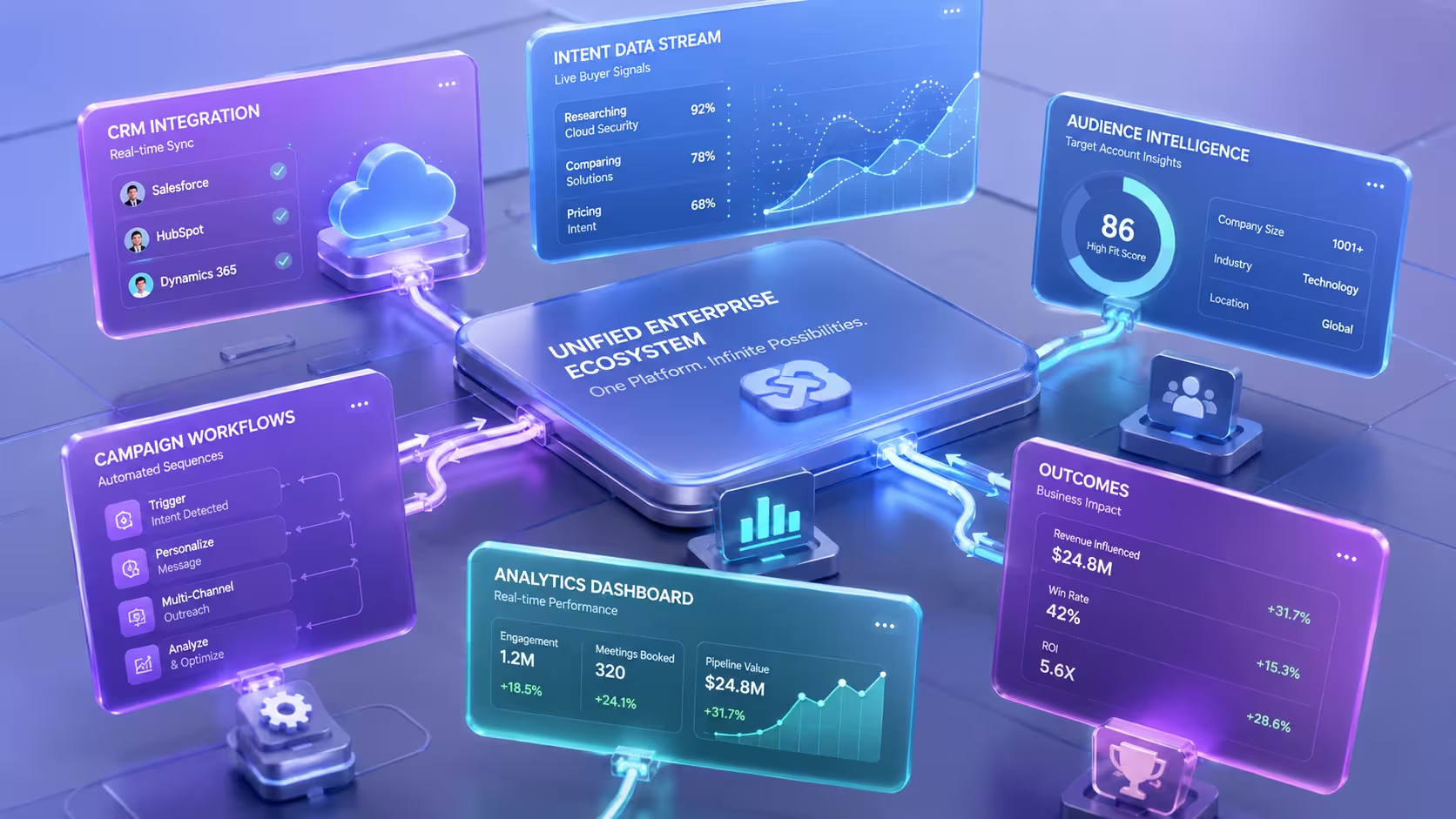
In-Depth Analysis of Leading Enterprise Tools
1. 6sense Revenue AI
When evaluating enterprise-grade ai account based marketing tools, 6sense stands out for its unmatched capability to unmask the B2B “dark funnel.” The platform uses its patented 6signal technology and natural language processing to identify anonymous web traffic, matching unstructured IP activity to verified company profiles. Its predictive machine learning algorithms automatically categorize target accounts into distinct buying stages Target, Awareness, Consideration, Decision, and Purchase allowing sales reps to reach out at the precise moment an account enters an active buying window.
2. Demandbase One
Demandbase is a pioneer among enterprise ai account based marketing tools, offering a unified account intelligence platform that combines B2B advertising, real-time intent data, and sales alignment. Demandbase One ingests billions of monthly B2B intent signals through its proprietary data co-ops and combines them with first-party CRM data. Its AI engine dynamically triggers automated ad campaigns on LinkedIn and programmatic display networks as soon as a target account displays high purchase intent.
3. Factors.ai
For organizations prioritizing rapid setup, cookieless account tracking, and transparent revenue attribution, Factors.ai delivers exceptional value. Unlike legacy enterprise systems, Factors.ai leverages AI to correlate website visitor identity, intent keyword surges, and marketing touchpoints directly to pipeline creation. This makes it one of the most agile ai account based marketing tools for mid-market and scaling enterprise B2B teams looking to optimize multi-channel ad spend.
4. Terminus ABM Platform
Terminus specializes in multi-channel account engagement, allowing revenue teams to deliver personalized messaging across programmatic display, connected TV (CTV), LinkedIn, and email signatures. Its AI orchestration engine continuously evaluates account engagement scores, ensuring marketing teams automatically shift ad budgets toward high-value accounts that show decreasing pipeline resistance.
5. RollWorks
RollWorks offers a powerful, accessible framework for identifying target account lists, engaging decision-makers, and measuring campaign impact. Its machine learning models analyze historical deal data to build automated lookalike audiences, discovering untapped enterprise accounts that match your highest-performing customer profiles.
6. Metadata.io
Metadata.io takes a unique approach to B2B marketing by acting as an autonomous campaign execution platform. Rather than requiring marketers to manually build hundreds of ad variations, Metadata’s AI engine automatically generates, tests, and optimizes combinations of ad copy, visuals, target audiences, and bidding strategies across Facebook, LinkedIn, and Google Ads to maximize cost-per-qualified-lead (CPQL).
The 4 Pillars of AI-Powered Enterprise ABM
Executing a successful B2B enterprise strategy requires a structured framework that connects data discovery directly with automated campaign execution. By grounding your strategy in modern ai account based marketing tools, revenue teams can replace fragmented, manual marketing tactics with an integrated engine built on four fundamental pillars.
Pillar 1: Predictive Account Selection & Intent Data Analysis
The foundation of any ABM framework is deciding exactly which accounts deserve your sales and marketing capital. Rather than relying on static criteria like basic company size or generic industry classification, enterprise ai account based marketing tools utilize predictive machine learning algorithms to uncover high-propensity accounts. These systems continuously monitor first-party website interactions alongside third-party intent data co-ops, calculating real-time engagement scores. This ensures marketers direct their advertising budget exclusively toward accounts actively exhibiting open buying behavior.
Pillar 2: Dynamic & Hyper-Personalized Content Generation
Generative artificial intelligence has fundamentally reshaped how content is personalized for target enterprise buyers. Once an account is identified, top-tier ai account based marketing tools dynamically customize digital touchpoints across the buyer journey. This includes altering website landing page headlines, swapping industry-specific case studies in real time, and tailoring ad copy to address specific pain points. Instead of manual content creation, AI algorithms deliver personalized messaging at scale without overwhelming internal creative teams.
Pillar 3: Sales & Marketing Revenue Synchronization
Historically, misalignment between sales and marketing teams has led to dropped leads and wasted pipeline opportunities. Modern ai account based marketing tools solve this by creating a centralized revenue intelligence layer inside platforms like Salesforce and HubSpot. When a target account displays a sudden surge in intent keywords or visits high-value pricing pages, the AI engine automatically alerts the assigned account executive. Furthermore, these platforms provide sales reps with contextual conversation summaries and talking points aligned with the exact content the account recently consumed.
Pillar 4: Multi-Channel Automated Campaign Orchestration
Enterprise buyers interact across dozens of digital touchpoints before ever contacting a sales representative. Leading ai account based marketing tools orchestrate synchronized, multi-touch campaigns across programmatic display networks, LinkedIn sponsored content, personalized email workflows, and direct outreach. When an account moves from the awareness phase to the decision stage, the platform automatically shifts ad creative and adjusts email messaging sequences without requiring manual campaign adjustments.
Step-by-Step Framework: Implementing AI ABM in Your Enterprise
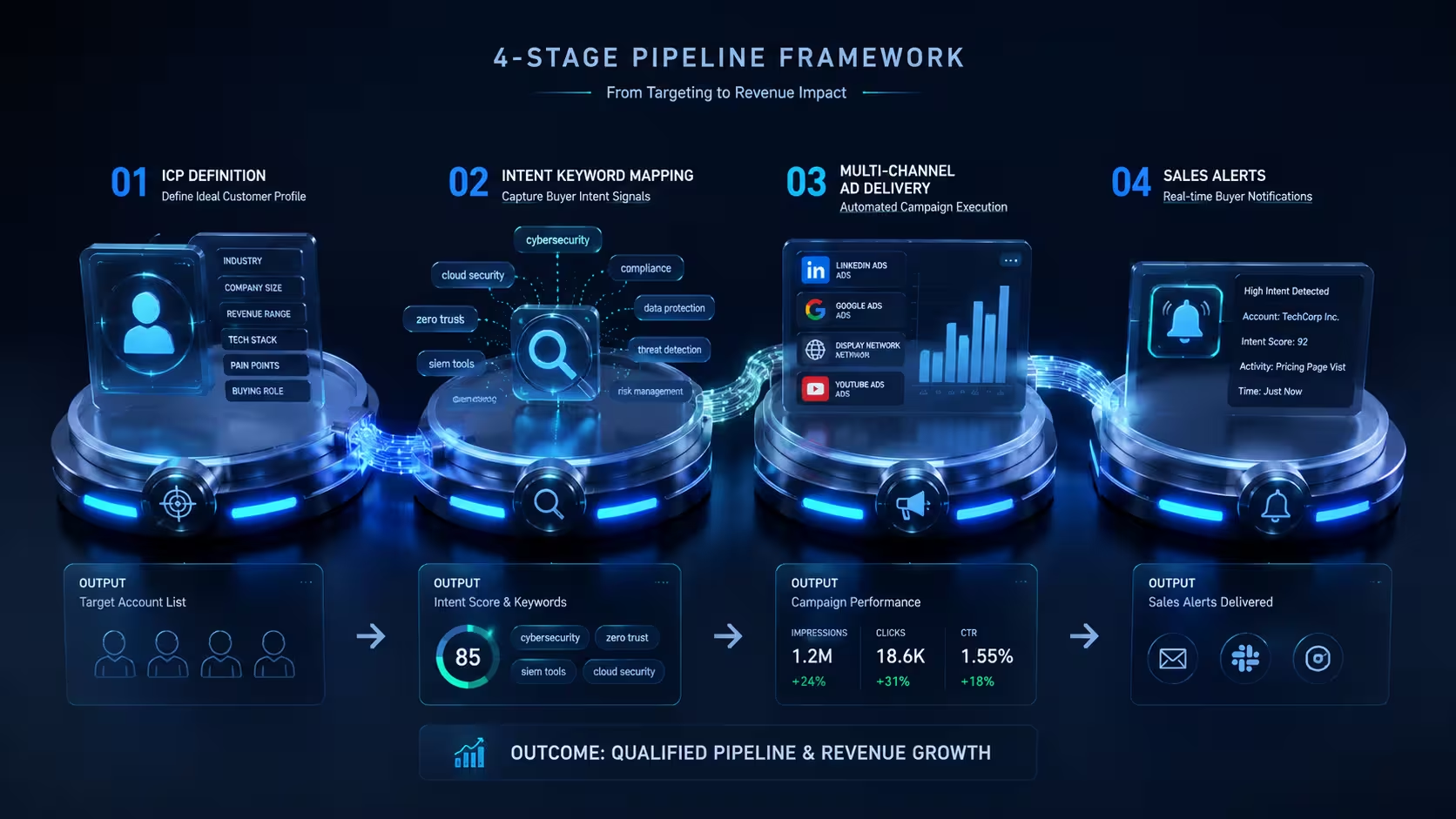
Transitioning an enterprise B2B organization from legacy lead generation to an AI-driven ABM model requires a methodical execution playbook. Deploying modern ai account based marketing tools without a structured framework often results in fragmented data and disjointed buyer experiences.
Below is a field-tested four-step implementation roadmap designed to help enterprise revenue leaders operationalize AI ABM efficiently.
Step 1: ICP Refinement & Data Ingestion
Before launching campaigns, your revenue team must define its ideal customer profile based on real historical performance rather than assumptions. Modern ai account based marketing tools connect directly to your CRM (e.g., Salesforce, HubSpot) and data warehouses to analyze closed-won deal patterns. The AI algorithm evaluates firmographics, technographics, and historical deal sizes to automatically identify high-margin target accounts and exclude low-propensity prospects.
Step 2: Intent Keyword Mapping & Account Tiering
Once the core database is established, map specific intent clusters aligned with your product’s core value proposition. Configure your ai account based marketing tools to monitor surge topics across dark social, tech review sites, and B2B publication networks. Based on real-time intent scores, segment your target accounts into three structured tiers:
- Tier 1 (Strategic 1:1 ABM): High-value target accounts ($250k+ ACV) requiring hyper-personalized microsites and custom 1-to-1 collateral.
- Tier 2 (ABM Lite / 1:Few): Clusters of 50 to 200 accounts grouped by industry vertical, receiving industry-tailored messaging.
- Tier 3 (Programmatic ABM): Broad lists of 500+ accounts targeted through automated programmatic ads and dynamic website personalization.
Step 3: Multi-Channel Automated Campaign Launch
With account tiers established, orchestrate coordinated campaign delivery across primary digital channels. Specialized ai account based marketing tools automatically trigger targeted programmatic display ads, LinkedIn sponsored content, and dynamic website alterations when an account’s intent score crosses defined thresholds. Simultaneously, generative AI tools build tailored email copy and outreach templates matching the specific pain points identified during the intent research phase.
Step 4: Real-Time Deal Execution & Sales Handoff Protocols
The final step is establishing automated sales enablement protocols. When a target enterprise account engages with your personalized ad content or visits high-intent pages, integrated ai account based marketing tools route real-time alerts directly to assigned account executives via Slack, Microsoft Teams, or CRM task notifications. This ensures sales reps reach out while account interest is at its peak, supported by AI-generated battlecards and context summaries.
Key Metrics & Measuring ROI in AI ABM

Measuring the return on investment (ROI) of an enterprise ABM initiative requires a fundamental shift in reporting metrics. Traditional marketing frameworks evaluate success based on top-of-funnel vanity metrics such as total page impressions, raw lead volume, and whitepaper downloads. However, enterprise revenue leaders leveraging ai account based marketing tools must focus on account-level progression, pipeline velocity, and closed-won revenue impact.
1. Account Engagement Score (AES) & Buying Committee Penetration
Because enterprise purchasing decisions involve multi-threaded buying committees, tracking individual contact activity is insufficient. Modern ai account based marketing tools calculate aggregate Account Engagement Scores by applying weighted values to distinct interaction types—such as executive site visits, product comparison page views, and ad click-throughs. Additionally, tracking your buying committee penetration rate ensures your marketing campaigns engage finance, IT, and operational stakeholders rather than a single isolated contact.
2. Pipeline Velocity & Deal Stage Progression
Pipeline velocity measures the speed at which qualified target accounts transition from early discovery to closed-won revenue. By deploying predictive AI models, organizations eliminate cold, non-responsive accounts from the sales pipeline earlier in the cycle. The formula for pipeline velocity evaluates four key components:
Pipeline Velocity = (Active Target Accounts × Average Deal Size × Win Rate) / Sales Cycle Length (in Days)
Advanced ai account based marketing tools increase pipeline velocity by providing revenue teams with real-time intent alerts, enabling immediate sales follow-up when buying interest reaches its peak.
3. Average Contract Value (ACV) & CAC Efficiency
One of the clearest indicators of successful AI ABM execution is a substantial increase in Average Contract Value (ACV). Industry benchmarks show that targeted, multi-threaded enterprise ABM deals yield significantly higher ACV compared to traditional broad-net lead generation. Furthermore, because automated ai account based marketing tools eliminate ad spend wasted on out-of-market accounts, organizations typically achieve a lower Customer Acquisition Cost (CAC) while securing larger enterprise deals.
4. Multi-Touch Revenue Attribution & Pipeline Influence
Proving marketing impact to C-suite executives requires robust revenue attribution models. Integrated ai account based marketing tools track first-party and third-party digital touchpoints across 6 to 18-month buying cycles, linking early programmatic ad impressions directly to late-stage pipeline creation. This data-driven clarity enables marketing leaders to justify software stack investments and reallocate budgets toward high-performing engagement channels.
Frequently Asked Questions (FAQs)
Q1: How do AI account based marketing tools improve target selection?
Modern ai account based marketing tools improve account selection by replacing static firmographic criteria with dynamic intent data. Instead of target lists based solely on company revenue or headcount, AI models analyze real-time third-party search surges, content consumption, and dark social activity to identify accounts actively in a buying window.
Q2: Which AI ABM tools integrate best with Salesforce and HubSpot?
Leading platforms such as 6sense Revenue AI, Demandbase One, and Factors.ai offer native, bi-directional integrations with major enterprise CRMs like Salesforce and HubSpot. These ai account based marketing tools automatically sync account engagement scores, intent keyword surges, and automated task alerts directly into rep workflows.
Q3: What is the average ROI of implementing AI-driven ABM?
Organizations deploying enterprise ai account based marketing tools typically report a 208% increase in pipeline value, a 30% reduction in customer acquisition costs (CAC), and up to a 50% decrease in sales cycle length due to targeted engagement and real-time intent triggers.
Q4: How do predictive intent signals work in enterprise marketing?
Predictive intent signals work by aggregating anonymized web traffic across thousands of B2B publishing networks and review portals (like G2). Specialized ai account based marketing tools process these signals using natural language processing to alert revenue teams when a target account displays high purchase intent.
Final Thoughts: The Future of Enterprise B2B Growth
The transition from volume-driven lead generation to account-centric precision is no longer optional for scaling enterprise brands. As B2B buying journeys become increasingly complex and fragmented, organizations that continue relying on manual outreach and static lead scoring will struggle to compete.
By adopting comprehensive ai account based marketing tools, enterprise revenue teams gain the predictive intelligence required to identify high-value accounts early, deliver dynamic multi-channel experiences, and align sales and marketing efforts around real intent data. Implementing these tools creates a predictable, highly efficient revenue pipeline that scales deal sizes while reducing acquisition costs in 2026 and beyond.