The digital information landscape has shifted fundamentally. For over two decades, web search meant typing a string of keywords into a search bar, hitting Enter, and manually sifting through ten blue links, sponsored advertisements, and SEO-optimized affiliate blogs. In 2026, that traditional paradigm is rapidly fading. When searching for the best ai search engine 2026 has to offer, modern users no longer tolerate clicking through multiple tabs just to find a single factual answer. Instead, conversational AI, real-time web retrieval, and multi-source synthesis have combined to deliver direct, cited, and accurate responses in seconds.
Identifying the best ai search engine 2026 requires understanding how natural language processing and web crawling have converged. Today’s generative search engines do not merely match keywords; they comprehend the intent behind multi-layered queries, cross-reference hundreds of real-time web sources, summarize complex topics, and cite every claim with clickable primary sources. Whether you are a software developer troubleshooting code, a student conducting scientific research, or a professional staying updated on industry trends, finding the best ai search engine 2026 can dramatically boost your daily productivity.
This comprehensive guide evaluates every top platform dominating the market today. We examine technical capabilities, indexing speed, source transparency, user experience, and pricing models to help you choose the best ai search engine 2026 for your specific workflow.
How Do AI Search Engines Work? Understanding Generative Retrieval
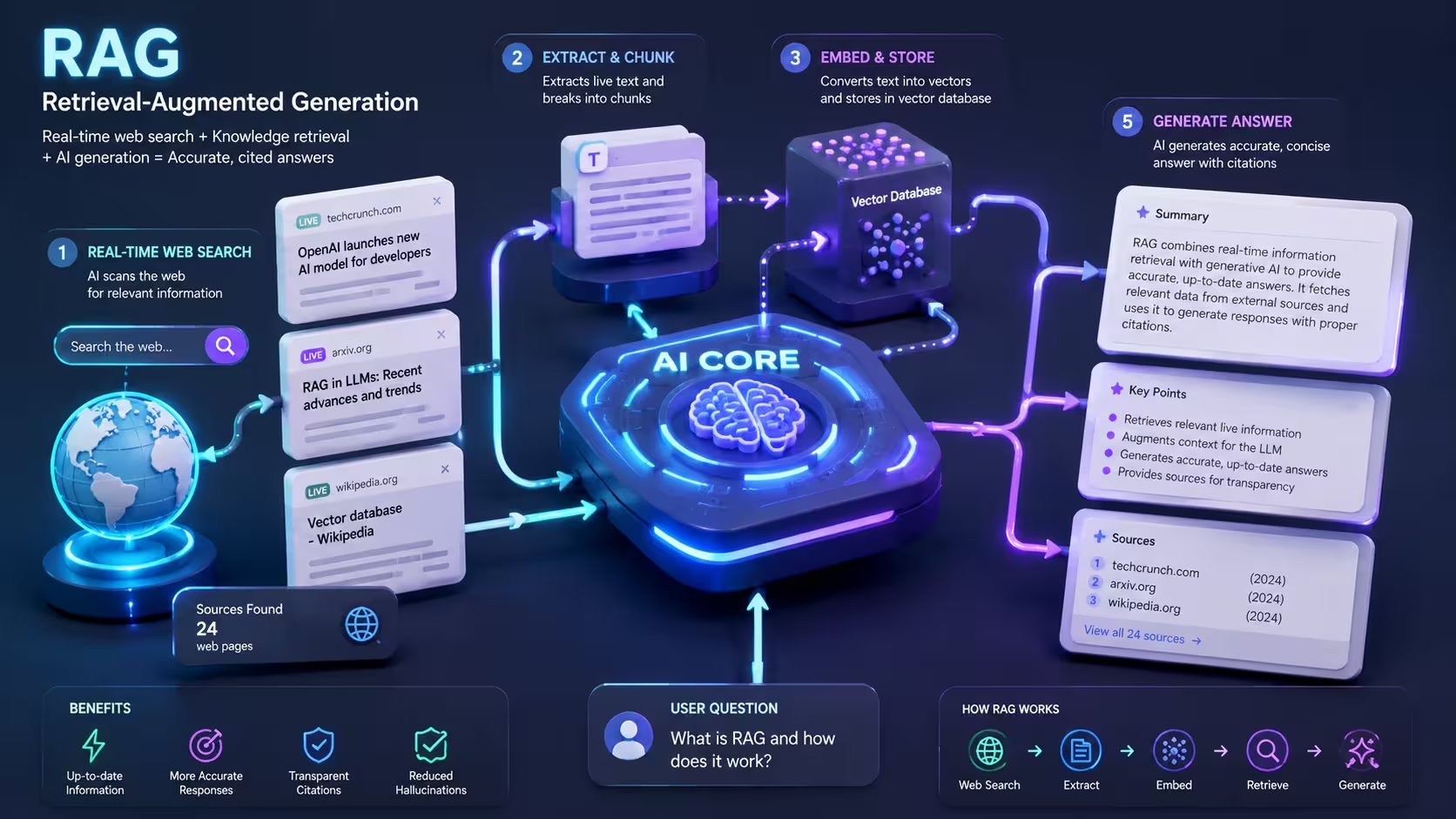
To understand why a platform earns the title of best ai search engine 2026, one must examine the underlying architecture that powers modern search. Unlike traditional search engines that rely purely on static web indexing, link graph algorithms, and keyword density, AI search engines leverage a framework known as Retrieval-Augmented Generation (RAG).
The Retrieval-Augmented Generation (RAG) Architecture
When you submit a query to a generative search engine, the system performs a multi-step execution pipeline:
- Query Intent Analysis: The Large Language Model (LLM) parses your query, decomposing complex questions into sub-queries to capture implicit context.
- Real-Time Web Indexing: Rather than relying solely on frozen training data, a modern platform competing to be the best ai search engine 2026 combines live web crawlers with specialized search APIs to fetch up-to-the-second web pages, news articles, and documents.
- Contextual Reranking & Vector Search: The system converts retrieved web snippets into vector embeddings, filtering out duplicate content, promotional spam, and low-quality domain signals.
- LLM Synthesis & Inline Citation: The language model synthesizes the filtered data into a cohesive, natural language summary while injecting inline footnotes linking directly to the cited source materials.
This real-time web grounding ensures that the best ai search engine 2026 avoids outdated knowledge cutoff limits, delivering hallucination-resistant answers backed by verifiable web references.
Hallucination Prevention & Real-Time Verification Systems
One of the biggest technical breakthroughs in identifying the best ai search engine 2026 offers is how modern platforms tackle AI hallucinations. Earlier generative models often fabricated citations or mixed up historical facts. Today, top generative search engines employ multi-layer cross-verification algorithms before delivering final summaries:
- Cross-Source Triangulation: Before presenting a claim as fact, the retrieval engine checks if the statement appears across at least three independent, high-authority web domains.
- Automated Confidence Scoring: Low-confidence data is automatically omitted or explicitly flagged with uncertainty disclaimers, ensuring users relying on the best ai search engine 2026 receive reliable data.
- Direct Citation Mapping: Sentences are mapped line-by-line to raw HTML snippets from live web pages, allowing users to perform instant click-through verification.
Best AI Search Engines 2026: Feature Breakdown
| AI Search Engine | Best For | Real-Time Web Access | Primary AI Models | Free Tier Available? | Transparency / Citation Level |
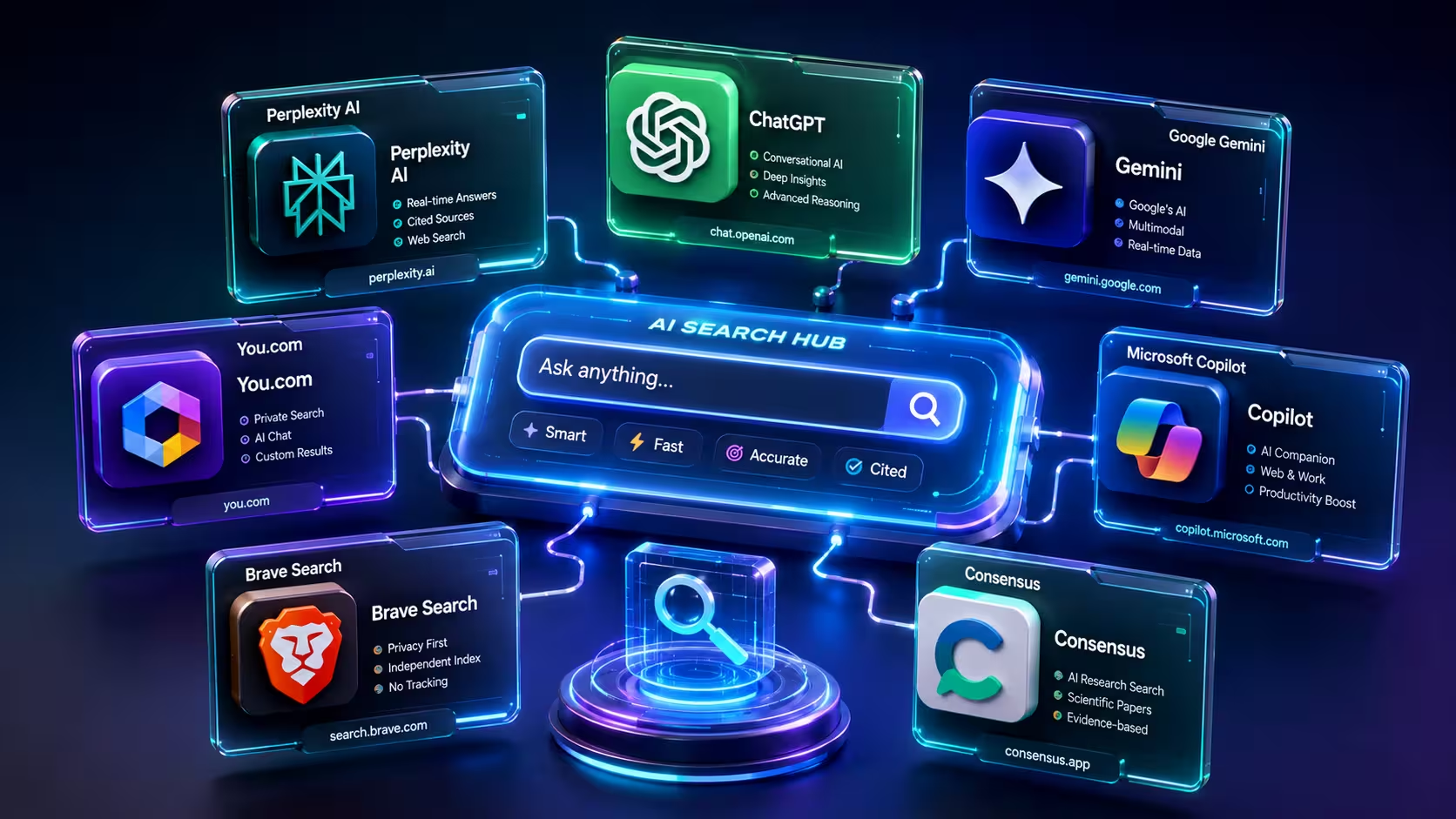
| Perplexity AI | Deep Research & Fact Verification | Yes (Live) | Sonar, GPT-4o, Claude 3.5 | Yes | Exceptional (Inline Footnotes) |
| ChatGPT Search | Conversational & Multi-Turn Queries | Yes (Live) | GPT-4o / GPT-5 Series | Yes | High (Side Panel Sources) |
| Google AI Mode & Gemini | Ecosystem Integration & Speed | Yes (Native Index) | Gemini 3 / Gemini 3.1 Pro | Yes | Moderate (Expandable Cards) |
| You.com | Developer & Multi-Agent Search | Yes (Live) | YouAgent, Claude, GPT-4o | Yes | High (Code & Text Sources) |
| Microsoft Copilot | Enterprise & Office 365 Users | Yes (Bing Index) | Custom GPT-4o Architecture | Yes | Moderate (Bing Citations) |
| Brave Search AI | Privacy-First & Independent Search | Yes (Brave Index) | Custom Local LLMs + Leo | Yes | High (No User Tracking) |
| Consensus | Academic & Scientific Literature | Yes (Semantic Scholar) | Specialized Research LLM | Yes | Absolute (Peer-Reviewed Papers) |
Top 7 AI Search Engines Ranked & Reviewed
1. Perplexity AI: Best Overall AI Search Engine for Cited Research
Perplexity AI is widely regarded as the best ai search engine 2026 for deep research and citation transparency. Built from the ground up as a dedicated answer engine, Perplexity eliminates search ads and promotional fluff, replacing them with structured, bulleted summaries backed by prominent numeric citations.
Key Features & Technical Highlights
- Pro Search (Multi-Step Reasoning): When faced with complex queries, Perplexity breaks down questions into multiple search steps, asking clarifying questions when necessary to refine its research path.
- Model Selection: Users on the Pro plan can toggle between leading AI models, including OpenAI’s latest release, Anthropic’s Claude 3.5 Sonnet, and custom fine-tuned Sonar models based on Llama 3.
- Collections & Workspaces: Organize search threads into custom threads and project spaces, allowing team collaboration with shared context and instructions.
Many power users rank Perplexity as their primary best ai search engine 2026 choice due to Pro Search multi-step reasoning and deep source verification. For fact-checkers, technical writers, and business analysts, it remains an unbeatable best ai search engine 2026 candidate.
- Pros: Unmatched citation accuracy, zero display ad clutter, excellent mobile apps, and robust API options.
- Cons: Pro tier required for unlimited multi-step reasoning queries.
- Pricing: Free plan available; Pro plan at $20/month.
2. ChatGPT Search: Best Conversational All-in-One Search Tool
OpenAI’s integrated ChatGPT Search has quickly emerged as a top best ai search engine 2026 contender for conversational discovery. By embedding real-time web retrieval directly into the world’s most popular AI chatbot, OpenAI created a unified platform where users can move seamlessly from brainstorming to live web research.
Key Features & Technical Highlights
- Contextual Follow-Ups: Unlike traditional search bars where every query starts fresh, ChatGPT Search remembers the entire conversation history. You can ask follow-up questions, request formatting changes, or ask for deeper elaboration without re-typing keywords.
- Interactive Media & Maps: Integrates inline photos, weather maps, stock charts, and news feeds directly within conversational responses.
- Deep Research Mode: Executes long-running research sessions across hundreds of web pages to produce structured, multi-page reports.
If you already use ChatGPT for daily writing, coding, or brainstorming tasks, its native web access makes it the best ai search engine 2026 for seamless workflow integration. Its ability to maintain context over long conversations solidifies its position as a best ai search engine 2026 favorite.
- Pros: Natural conversational flow, memory features, world-class model capabilities, and vast plugin integrations.
- Cons: Source citations appear in a sidebar rather than inline for every sentence.
- Pricing: Free basic access; Plus tier at $20/month.
3. Google AI Mode & Gemini: Best Integrated Search Engine
Google AI Mode brings generative summaries directly into the global search bar, making it a default best ai search engine 2026 for billions of global users. Rather than forcing users to visit a separate website, Google seamlessly embeds AI Overviews and Gemini-powered synthesis at the top of traditional Search Result Pages (SERPs).
Key Features & Technical Highlights
- Direct Web Index Access: Leverages Google’s massive, real-time web index, providing unmatched freshness for breaking news, live sports scores, and immediate event updates.
- Multimodal Capabilities: Supports seamless multi-input search—you can snap a photo, upload a video, or attach a PDF and ask complex search queries about the media.
- Workspace Sync: Connects directly with Google Docs, Gmail, Drive, and Google Maps to query personal data alongside public web content.
With Gemini 3 integration, Google offers a strong case for the best ai search engine 2026 in terms of index depth and speed. For users deeply tied to Gmail, Docs, and Drive, it serves as the best ai search engine 2026 for connected productivity.
- Pros: Instant speed, massive web coverage, multimodal camera search, and zero additional setup required.
- Cons: Sponsored links and shopping ads still surround summaries on commercial queries.
- Pricing: Free integrated search; Gemini Advanced available at $19.99/month.
4. You.com: Best Multi-Agent Search Platform
You.com positions itself as a specialized best ai search engine 2026 tailored for developers, technical researchers, and power creators. It stands out by utilizing a multi-agent framework that routes queries to specialized AI sub-agents optimized for coding, writing, or mathematical analysis.
Key Features & Technical Highlights
- Custom AI Modes: Choose between Genius Mode for multi-step problem solving, Research Mode for exhaustive literature reviews, and Code Mode for generating and debugging software scripts.
- Model Agnostic Switcher: Effortlessly switch between top-tier foundation models depending on the task requirement.
- Developer API & Live Execution: Includes built-in code interpreters that execute Python code directly in the search environment to verify calculation results.
Custom AI agents and multi-model switching make You.com a versatile best ai search engine 2026 option for technical workflows that go beyond simple text summaries.
- Pros: Dedicated coding execution environment, customizable agent modes, and strong privacy options.
- Cons: The interface can feel overwhelming for basic, everyday search queries.
- Pricing: Free basic mode; YouPro tier at $15/month.
5. Microsoft Copilot: Best for Office 365 & Enterprise Productivity
Microsoft Copilot remains a powerful best ai search engine 2026 for enterprise users tied to the Office 365 ecosystem. Powered by OpenAI’s GPT models and backed by Bing’s web index, Copilot delivers real-time web search combined with enterprise-grade security.
Key Features & Technical Highlights
- Enterprise Data Protection: Commercial tenant data is strictly protected, ensuring company queries and uploaded documents are never used to train public models.
- Microsoft 365 Graph Integration: Search across internal emails, Teams chats, SharePoint documents, and the open web simultaneously.
- DALL-E 3 Image Generation: Generates high-resolution images inline alongside search text summaries.
Integrating Bing’s web index with enterprise data safety makes Copilot a trusted best ai search engine 2026 for corporate environments.
- Pros: Strict commercial privacy safeguards, seamless Office 365 integration, and free access to GPT-4o class capabilities.
- Cons: Bing web index can occasionally return lower quality citations compared to Google.
- Pricing: Free web version; Copilot Pro at $20/month; Enterprise licensing available.
6. Brave Search AI: Best Privacy-First Option
Brave Search AI stands out as the best ai search engine 2026 for privacy-focused users who reject data tracking, profiling, and targeted advertising. Unlike competitors that wrap around Google or Bing indices, Brave built its own independent web index containing over 30 billion pages.
Key Features & Technical Highlights
- Independent Web Index: Zero reliance on Big Tech search indices, ensuring unbiased search results and resilient infrastructure.
- No Profiling or Query Logging: Your search history, IP address, and click data are completely anonymized and never tied to a personal profile.
- Summarizer AI Layer: Delivers concise, real-time AI summaries directly at the top of search results without sending personal identifying data to third-party AI labs.
By utilizing an independent web index, Brave delivers answers without compromising privacy, earning its place as a best ai search engine 2026 leader.
- Pros: Absolute privacy compliance, zero user tracking, independent infrastructure, and fast lightweight rendering.
- Cons: Index depth for ultra-niche or hyper-local queries can occasionally lag behind Google.
- Pricing: 100% Free; optional Brave Premium subscription available.
7. Consensus: Best for Academic & Scientific Literature
Consensus is uniquely engineered as the best ai search engine 2026 for academic and peer-reviewed scientific literature. Rather than searching the general web where blogs and opinion pieces dominate, Consensus queries a database of over 200 million scientific research papers.
Key Features & Technical Highlights
- Consensus Meter: Analyzes hundreds of peer-reviewed papers for a given health or scientific question and produces a percentage agreement meter (e.g., “88% of studies show X”).
- Evidence-Based Summaries: Every sentence in the generated summary is linked directly to a published paper, complete with impact factor scores and citation counts.
- Study Filter Controls: Filter search results by human trial status, sample size, publication year, and journal credibility.
Researchers, students, and medical professionals consistently rate Consensus as the best ai search engine 2026 for evidence-based answer synthesis.
- Pros: Completely eliminates web hallucination and blog clickbait; highly credible academic sourcing.
- Cons: Not intended for general everyday search queries (e.g., local weather or news).
- Pricing: Free basic queries; Pro plan at $8.99/month.
Key Factors When Selecting an AI Search Engine
Choosing the best ai search engine 2026 depends on your specific balance between speed, citation rigor, and privacy. Consider the following criteria before committing to a primary platform:
- Citation Transparency: Does the platform cite specific web pages with clickable inline links, or does it deliver unverified text blocks?
- Web Index Freshness: How quickly does the platform index breaking news? Real-time research requires live web access rather than cached indexes.
- Privacy Policy: Does the vendor track your queries to sell personalized ads or train public AI models?
- Subscription Value: Evaluating pricing models is essential when selecting the best ai search engine 2026 for individual or team use. Free tiers often suffice for casual browsing, but heavy research demands premium multi-step reasoning features.
Ultimately, test multiple platforms to discover which best ai search engine 2026 aligns with your daily habits and technical requirements.
- Multimodal Flexibility: Consider whether the platform can process complex visual inputs, voice queries, PDFs, and live video streams alongside traditional text inputs.
- API Availability & Custom Integrations: For developers and enterprise teams, selecting the right tool involves checking whether the vendor provides robust developer APIs to embed real-time web retrieval into custom internal tools and SaaS applications.
Traditional Search vs. AI Search Engines: The 2026 Shift
The shift away from ten blue links explains why searching for the best ai search engine 2026 has surged among digital workers. Traditional search engines reward content creators who optimize for keyword density and backlink authority, often resulting in bloated articles that hide answers under endless paragraphs.
Traditional Search Flow:
[ User Query ] ──► [ 10 Blue Links + Ads ] ──► [ Click Tab 1 ] ──► [ Skim Blog ] ──► [ Click Tab 2 ] ──► [ Manual Synthesis ]
Generative AI Search Flow:
[ User Query ] ──► [ RAG Web Retrieval ] ──► [ Direct AI Summary + Inline Citations ] ──► [ Verified Answer ]
By removing ad clutter and direct clickbait, adopting the best ai search engine 2026 becomes a major time-saver. Users receive synthesized answers instantly, clicking external links only when they require deeper verification.

The Impact on Web Content Creators & Digital Publishing
The shift toward generative retrieval is fundamentally altering how web content is produced. Web publishers using the most popular CMS platforms are no longer writing long, repetitive paragraphs purely to satisfy outdated keyword density algorithms. Instead, online media outlets must deliver concise, original research and authoritative data if they want to be retrieved and credited by modern AI indexing models. This transition is actively reducing search result bloat and rewarding genuine information quality across the internet.
Frequently Asked Questions (FAQs)
Q1: What makes Perplexity the best ai search engine 2026 for research?
Perplexity excels due to its multi-step pro search capabilities, source transparency, and ability to toggle between leading language models like Claude 3.5 and Sonar. It provides clear inline citations for every factual claim, eliminating the need to cross-check sources manually.
Q2: Is there a completely free option that rivals the best ai search engine 2026 paid plans?
Yes. Google AI Mode, ChatGPT Free Search, and Brave Search AI offer powerful generative answer capabilities completely free. While paid plans unlock unlimited deep research modes, free tiers are more than capable for daily web queries.
Q3: How do I know which best ai search engine 2026 respects user privacy?
Brave Search AI is the industry standard for privacy. It operates on an independent index, does not log search queries, and builds no user profile tracking data.
Q4: Will traditional search engines disappear as the best ai search engine 2026 market matures?
Traditional search engines will not vanish entirely, but their role is shifting. They remain vital for quick transactional queries, brand navigation, and local map lookups. However, for informational research, generative AI search engines have become the dominant choice.
Final Thoughts
The transition from legacy keyword searching to generative retrieval represents one of the most significant shifts in internet history. For decades, users adapted their thinking to match how search engines parsed text. Today, search tools have finally evolved to understand human context, nuance, and complex intent. By combining real time web grounding, vector synthesis, and conversational memory, modern answer engines have turned online research from a time-consuming chore into an instantaneous workflow.
As generative technology continues to advance, the boundaries between answering questions and executing actions will blur even further. Future retrieval platforms will not only find and summarize information, but they will also seamlessly execute multi-step workflows such as booking travel, compiling automated market reports, or writing code directly from live API documentation. Adapting to these conversational retrieval platforms today is no longer just a convenience; it is a foundational skill for staying productive in a fast-paced digital environment.
The era of manual link-skimming is over. The platforms highlighted in this guide represent the pinnacle of modern retrieval technology. By choosing the best ai search engine 2026 for your specific workflow whether it’s Perplexity for academic research, ChatGPT for conversational discovery, Google for ecosystem sync, or Brave for privacy you can reclaim hours of lost time and navigate the web with unprecedented efficiency.